
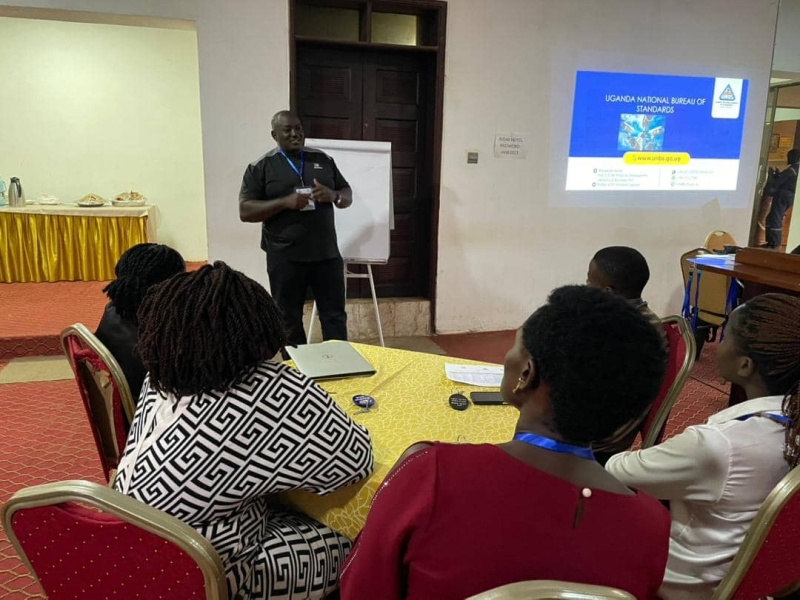
Uganda National Bureau of Standards (UNBS), has called on consumers, manufacturers and the media to work together in eliminating substandard goods from Uganda’s market.
The Head of Market Surveillance at the Daniel Arorwa, Speaking at the close of a four-day training on standards and metrology reporting for journalists, Arorwa said the media plays a central role in simplifying technical scientific information and empowering the public to make informed purchasing decisions.
Arorwa emphasized that while UNBS enforces standards, consumers also bear responsibility for the products they purchase.
He cautioned against buying goods from hawkers and informal traders with no fixed address, noting that such purchases make it nearly impossible to trace accountability in case of harm.
Arorwa clarified misconceptions surrounding certification, stressing that it is not a one-time approval but a continuous process.
“Certification is a journey. We pick samples, test them, give feedback, and work with manufacturers until the product meets the required standard,” he explained. “Only then can we assure the consumer that what they are picking from the shelf is safe.”
He warned manufacturers against bypassing certification processes and placing unverified goods on supermarket shelves.
Arorwa urged journalists to pay particular attention when reporting on sensitive products such as cosmetics, food, drinks and maternal health items.
He cited cosmetics containing hydroquinone as an example, warning that the chemical is a carcinogen linked to cancer.
He called on the media to repeatedly educate the public about the dangers of banned and smuggled products, saying government bans are issued for public protection.
On reporting maternal health issues and other sensitive matters, Arorwa urged journalists to uphold ethical standards.
He stressed that while the public has a right to information, journalists must balance that with privacy and dignity.
Arorwa also highlighted the role of legal metrology in ensuring fairness in trade. UNBS conducts periodic verification and calibration camps for weighing scales across the country.
He warned traders against hiding their weighing scales during verification exercises.
He cautioned consumers to be alert to improper weighing practices, particularly handheld scales not approved for trade.
Among the biggest challenges facing UNBS, Arorwa said, is public apathy.
He cited cases where consumers defend traders selling expired goods, arguing that enforcement officers are “taking someone’s capital.”
He urged consumers to demand quality just as they would demand the correct meal in a restaurant.
Arorwa concluded by reiterating that the fight against substandard goods is not solely the government’s responsibility.
He tasked journalists with disseminating accurate and simplified information about standards, certification and quality to help shift public mindset.











Disqus comments error!
Disqus shortname is required to use Disqus comments. Please ensure you have specify a valid registered Disqus shortname.