
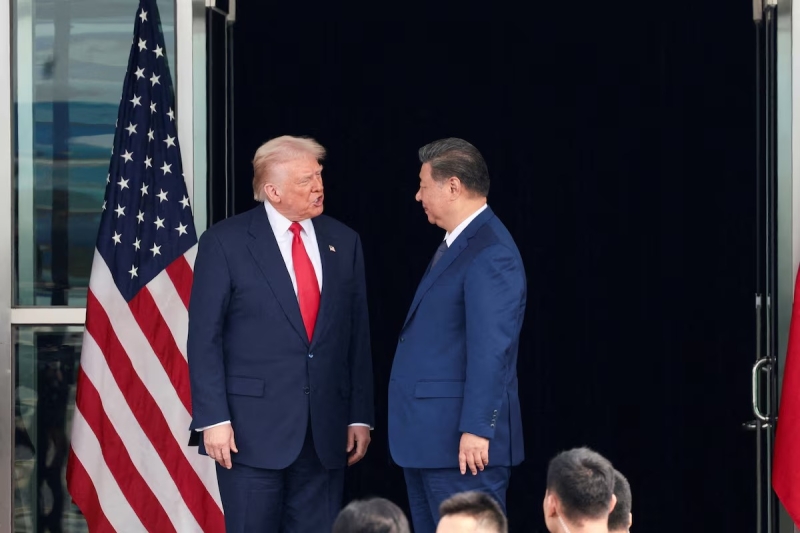
United States President Donald Trump left Beijing after a two-day summit saying he had struck "fantastic trade deals, great for both countries", but few details have emerged on what the two superpowers agreed.
Trump arrived for a high-stakes summit with Chinese leader Xi Jinping on Wednesday, accompanied by several CEOs: a high-profile business delegation spanning agriculture, aviation, electric vehicles and artificial intelligence (AI) chips.
Trade was near the top of the agenda despite recent tensions over the Iran war, and businesses hoped for key deals as well as an extension of the tariff truce that is due to expire in November.
The visit was defined by warm rhetoric and symbolism. Trump was wooed with a packed itinerary that included an honour guard, a state banquet, and an invitation to the exclusive compound where China's Communist Party leaders live and work.
The US president seemed impressed and invited Xi to the White House in September. He said talks had been "very successful", while Xi called it a "historic and landmark" visit.
China's Foreign Minister Wang Yi confirmed on Friday that Xi would visit the White House in September 2026.
But neither side has announced trade breakthroughs or significant business deals.
President Trump, however, spoke to reporters aboard Air Force One and said China has agreed to buy 200 Boeing jets, with a potential commitment to buy an additional 750 planes.
Trump also said American farmers will be happy with his trade deals because China would be buying "billions of dollars" of soybeans.
There has been no confirmation of any deals or purchases from the Chinese.
If the Boeing orders are finalised, this would be the plane-maker's first major Chinese deal in nearly a decade.
The war against Iran and the resulting blockade of the Hormuz Strait was a key part of the agenda, and Trump entered the talks hoping for Chinese co-operation on the Iran conflict and the oil market.
Trump has said that China could use its influence to encourage Iran to stabilise flows through the Strait of Hormuz, a key global energy artery.
"[Xi would] like to see the Hormuz Strait open, and said 'if I can be of any help whatsoever, I would like to help,'" Trump told Fox News.
The Chinese foreign ministry was more vague, and released a statement on Friday calling for "a comprehensive and lasting ceasefire".
"Shipping lanes should be reopened as soon as possible in response to the calls of the international community," it added.
Chinese readouts indicated that while the Middle East was discussed, details were limited.
The conflict is a challenge for the Chinese economy too. Oil price volatility and repeated disruptions to supply routes have increased China's import costs and pushed up prices across the world.







Disqus comments error!
Disqus shortname is required to use Disqus comments. Please ensure you have specify a valid registered Disqus shortname.