
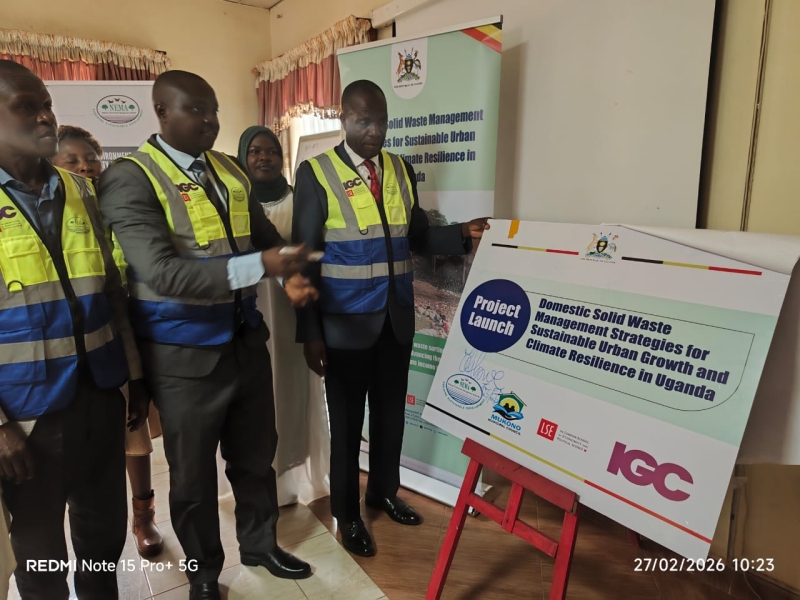
The National Environment Management Authority (NEMA), in partnership with Mukono Municipality and with funding from the International Growth Centre (IGC) based at the London School of Economics, has launched a one-year pilot project aimed at transforming waste management practices in Mukono.
The initiative seeks to train residents on how to reduce indiscriminate waste disposal and instead turn domestic solid waste into useful and income-generating products. The project has kicked off in Upper Nabuuti village, with Kiwanga village designated as a control site to monitor and compare progress.
The program was officially launched by Victor Nahabwe, Senior Manager for Environment Enforcement and Field Operations at NEMA, who represented the Executive Director, Dr. Akankwasa Barirega.
Nahabwe explained that the one-year pilot project, titled “Domestic Solid Waste Management Strategies for Sustainable Urban Growth and Climate Resilience in Uganda,” is designed to promote sustainable waste practices at the household level.
Upper Nabuuti village will receive intensive training and community engagement, while Kiwanga will serve as a comparison point to measure behavioral and environmental change.
If successful, the project will be expanded to the entire Mukono Municipality and later rolled out nationwide.
According to Nahabwe, Mukono was strategically selected for several reasons. The municipality hosts one of the few licensed waste management facilities in Uganda and has a number of licensed waste handlers engaged in the waste business.
Situated near Kampala, Mukono generates substantial volumes of municipal waste, making it an ideal testing ground for scalable solutions.
A central message of the project is changing public perception about waste.
Residents will be trained to: Sort waste at the household level, Separate biodegradable from non-biodegradable materials, Use biodegradable waste for composting, Channel plastics and metals to licensed handlers for recycling and understand proper collection and transportation processes
Biodegradable waste can be turned into compost for agriculture, while non-biodegradable materials such as plastics and metals can be sold to recycling companies, creating income opportunities.
Community scouts similar to Village Health Teams — will be deployed to coordinate between households, NEMA and the municipality to ensure sustained engagement and monitoring.
The Country Economist at the IGC, Maria Orjuela Pava, revealed that the center has committed £20,000 under its Small Projects Facility (SPF) to support the one-year pilot.
The IGC, a research and policy center operating in Uganda since 2011, focuses on sustainable and inclusive economic growth. Waste management falls under its urban growth policy cluster.
She added that the pilot will generate evidence to inform national policy.
The project is expected to conclude by the end of the year, after which an impact assessment will guide decisions on scaling up.
Mukono Municipality officials acknowledged that waste management remains one of their biggest challenges.
Francis Byabagambi, the Town Clerk of Mukono, described poor waste collection as a growing threat to public health, environmental sustainability and physical planning.
Scavengers both human and animal — are common sights at dumping sites, posing health risks. Drainage systems frequently clog during heavy rains due to indiscriminate dumping of garbage in streams and waterways.
George Masengere, the municipality’s environmental officer, revealed alarming statistics: out of the 270 tons of waste generated daily, only 45 tons are collected.
Municipal leaders emphasized that waste management is not solely the responsibility of local authorities but also of residents who generate the waste.
The initiative aligns with broader goals of climate resilience, public health improvement and sustainable urban growth.
If Upper Nabuuti demonstrates measurable improvement compared to Kiwanga, the model could be adopted across Mukono and eventually replicated nationwide.
As the program unfolds over the next year, stakeholders will be watching closely to see whether a shift in mindset — from viewing waste as a problem to recognizing it as a resource — can spark lasting environmental and economic transformation.







Disqus comments error!
Disqus shortname is required to use Disqus comments. Please ensure you have specify a valid registered Disqus shortname.