
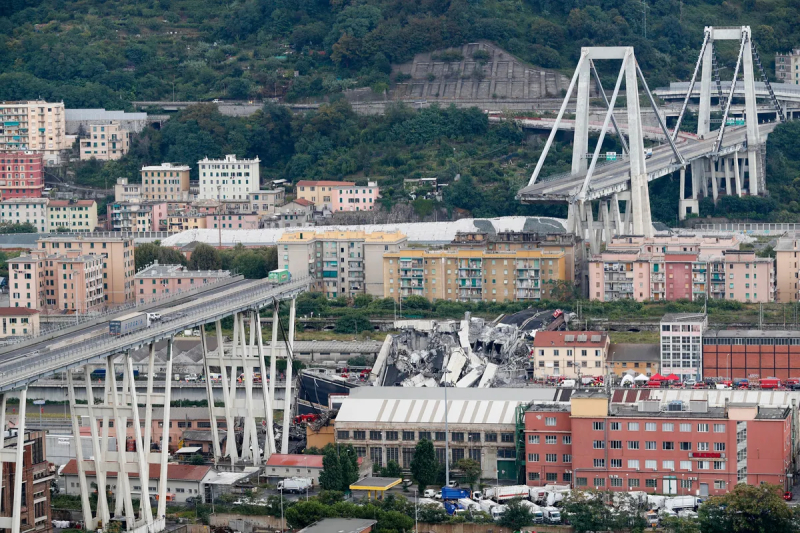
The former head of Italy's motorway operator has been given a 12-year prison sentence over the collapse of Genoa's Morandi bridge in August 2018.
Prosecutors had asked for a far longer jail term for Giovanni Castellucci, ex-chief executive of Autostrade per l'Italia (Aspi).
Forty-three people died when the motorway bridge running through the city came down in a rain storm at the height of the holiday season, sending cars and lorries plummeting to the ground.
Castellucci, who is already serving a six-year jail term for a 2013 road disaster, was one of 57 defendants on trial in Genoa. Another top motorway official, Michele Donferri Mitelli, has been given 11 years in jail.
Emmanuel Diaz, whose brother Henry died in the bridge collapse, told Italian TV he was "very satisfied" with the verdict, while Egle Possetti, whose sister and her family were all killed, said she thought the 12-year term handed to Castellucci was "acceptable".
It was a first stage that "opens up a ray of light", said Possetti, who heads the Morandi bridge victims' memorial committee.
Giovanni Castelucci was not in court to hear the verdicts, read out by Judge Paolo Lepri, and his lawyer said they would continue to fight for his innocence on appeal, describing the verdict as profoundly flawed.
The former number two at the motorway operator, Paolo Berti, was handed a five-and-a half-year jail term, seven years less than prosecutors had sought.
Thirty-two people were found guilty by the court on Thursday, and several officials were given sentences of just under two years in prison. Another 25 were either acquitted or cleared because the offences came under a statute of limitations.
In total, prosecutors had asked for the 57 defendants to be given 400 years in jail on charges including manslaughter and failing to maintain the viaduct, which was designed by Riccardo Morandi in 1967.
All the defendants had denied doing anything wrong.
While prosecutors had argued that maintenance of the ageing structure had been repeatedly delayed and that warning signs had been ignored, defence lawyers blamed the disaster on a design flaw, and the fact that a specific cable was encased in concrete.
It took almost four years of investigation before the case came to trial and another four years for the trial to be heard, during more than 280 hearings.
Among the defendants on trial were engineers from the maintenance firm Spea and former officials from both the transport ministry and the Aspi motorway operator's parent company Atlantia.
Spea's former chief executive, Antonino Galatà, was given a five-and-a-half year prison term, while Mauro Coletta, the former top official in charge of the ministry's motorway directorate, received five years.
On the eve of the trial, the current head of Aspi, Arrigo Giana, made his company's first public apology for the bridge collapse, saying that "the actions and decisions of some people left indelible scars".
Giana stressed that his company was different now, with new managers monitoring the network and planning ahead to eliminate risks.
For one 18-year-old called Cesare, whose father Andrea Cerulli was among the 43 victims, the apology from Aspi was nothing but "crocodile tears". Cesare was 10 when his father was killed.
"Unfortunately, these people lack tact and humanity," the teenager told La Repubblica newspaper.
The remains of the old bridge were blown up in early 2019 and a new structure called the San Giorgio bridge was inaugurated the following year, just two years after the disaster.
Designed by Genoa-born architect Renzo Piano, the new viaduct features sail-like pillars, evoking the port city's long maritime history.








Disqus comments error!
Disqus shortname is required to use Disqus comments. Please ensure you have specify a valid registered Disqus shortname.