
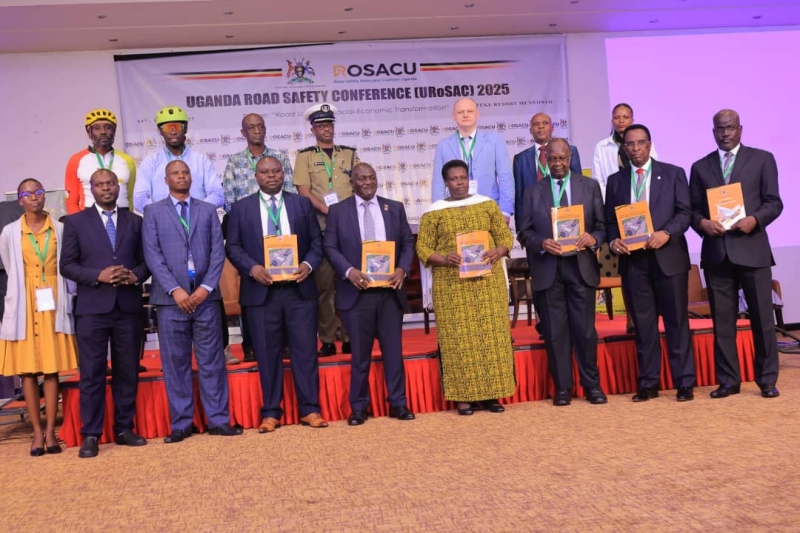
Uganda continues to pay a heavy toll on its roads, with an average of 14 people losing their lives each day including two schoolgoing children according to the Ministry of Works and Transport.
At the Road Safety Conference 2025, held on May 14 under the theme “Road Safety for Socio-Economic Transformation” at Speke Resort Munyonyo, government leaders, civil society actors and private-sector stakeholders gathered to chart a path toward halving road fatalities and serious injuries by 2030.
President Yoweri Kaguta Museveni, in a message delivered by Vice President Jessica Alupo, described the road carnage as a senseless national tragedy and vowed to prioritize road safety in Uganda’s development agenda.
He reaffirmed government commitment to significantly reduce traffic deaths and injuries by 50% in line with both the National Road Safety Action Plan (2021–2026) and Sustainable Development Goal 3.6.
“The NRM government has invested heavily in physical infrastructure, but this progress must not be marred by death and recklessness on our roads,” Museveni’s message read. “We cannot continue to lose our people especially children to preventable accidents. We must defeat road carnage just like we defeated killer diseases.”
President Museveni commended the Ministry of Works and Transport and security agencies for rolling out the Intelligent Transport Monitoring System (ITMS), a landmark initiative in partnership with Joint Stock Company Global Security that will digitize traffic management in Uganda.
The system introduces digital number plates embedded with GPS tracking, AI-powered CCTV cameras, automated penalty systems, and real-time traffic monitoringto curb speeding, reckless driving, and other road offences.
Vice President Alupo, who officially opened the conference, also launched two key government initiatives: the Safe School Zones Establishment Guide and the **Non-Motorised Transport (NMT) Manual.
These tools are designed to improve safety around schools by mandating pedestrian walkways, zebra crossings, signage, and traffic supervisors; and to promote inclusive, people-first urban planning that protects pedestrians and cyclists.
“Our children are dying on the way to school. Our cities are growing, and we must build them to be safe for everyone. Road safety is a public health issue and a development issue,” Alupo stressed.
According to the Ministry of Works and Transport, Uganda recorded 25,107 road crashes and 5,144 deaths in 2024 alone. Speeding and reckless driving contributed to 44.5% of these fatalities.
“Each death is a personal tragedy and a national loss,” The Minister for Works and Transport Gen Katumba Wamala noted in his message. “This is not just about numbers. These are breadwinners, mothers, children—our future. We must act with urgency.”
The World Health Organization has previously ranked Uganda among the top 10 countries with the highest road fatality rates globally.
Beyond lives lost, road crashes carry a heavy economic cost. The World Bank estimates that road traffic injuries cost low- and middle-income countries like Uganda up to 5% of GDP annually.
Improving road safety is therefore critical to achieving Vision 2040, Parish Development Model goals, and transitioning into a middle-income economy.
“Safe roads are an enabler of trade, education, healthcare, and prosperity. We must design systems and cities where movement does not come at the cost of human lives,” Wamala emphasized.
Owen Muhumuza, the ITMS Training Manager, said more than 2 million vehicles and 1.4 million boda bodas will be integrated into the system, which is currently in its pilot phase.
“Offenders will be identified and fined instantly through the Express Penalty System Auto (EPSauto). This not only enforces discipline but also enhances non-tax revenue collection,” Muhumuza said.
The conference brought together representatives from government, the private sector, academia, and civil society under the Road Safety Advocacy Coalition Uganda (ROSACU).
Stakeholders committed to enhancing public education, law enforcement, emergency response, and data systems to better prevent and respond to road crashes.





Disqus comments error!
Disqus shortname is required to use Disqus comments. Please ensure you have specify a valid registered Disqus shortname.