
Garbage disposal has emerged as one of the most pressing environmental challenges in Mukono Town, with many residents resorting to indiscriminate dumping in open spaces, along roadsides and in wetlands.
Residents blame high fees charged by private waste collection companies, while Mukono Municipality cites insufficient funding to provide reliable garbage collection services across the growing urban area.
In a bid to address the crisis, the National Environment Management Authority (NEMA), in partnership with the International Growth Centre (IGC) at the London School of Economics and Mukono Municipality, on Friday launched a one-year pilot project titled “Domestic Solid Waste Management Strategies for Sustainable Urban Growth and Climate Resilience in Uganda.”
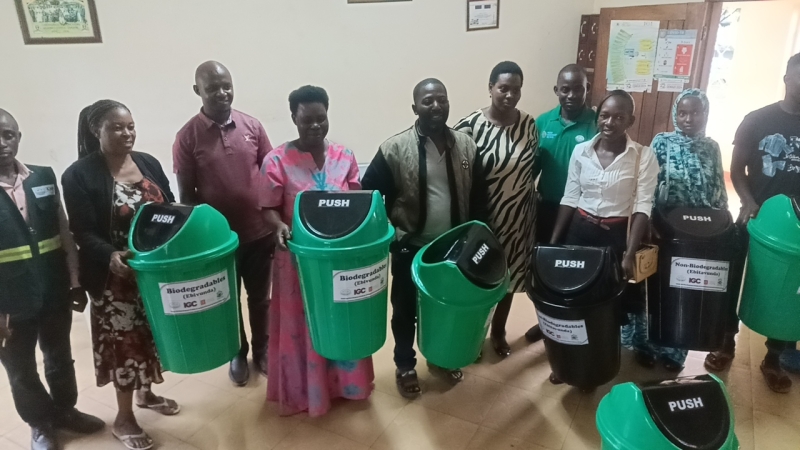
The initiative began with the distribution of 100 specially designed dustbins (buckets) to 50 households in Upper Nabutti Village, an area already showing some positive efforts in waste handling.
The dustbins are intended to enable households to segregate waste at source into biodegradable (organic) and non-biodegradable categories, reducing scattered dumping, promoting recycling, and allowing residents to earn income from sellable waste materials.
The handover ceremony took place at Mukono Municipality headquarters.
Deputy Resident District Commissioner Titwe Rhondah Kagaaga, urged beneficiaries to make good use of the bins and explore income-generating opportunities from waste.
“Proper utilisation of these bins will not only keep our town clean but also turn waste into wealth,” she said.
NEMA Research Unit officer Edwin Baluku, who led the distribution, explained the project’s three main objectives, achieve waste sorting at source (biodegradable versus non-biodegradable), Enable households to generate income by selling recyclable materials and promote behavioral change towards proper waste management while evaluating the effectiveness of existing environmental laws.
“Our survey showed that Mukono Municipality has already made significant efforts in waste management, we felt supporting them would build on what they are already doing,” Baluku said.
He added that the pilot, which will run for one year at a cost of over €20,000(UGX 80 million), is designed as a learning project.
“If it proves successful, we will roll it out first across Mukono Municipality and eventually to other districts and urban centers nationwide,” Baluku stated.
George Masengere, Mukono Municipality’s Senior Environmental Officer (also referred to as Principal Government Officer in some remarks), welcomed the partnership.
“This initiative will greatly reduce the problem of scattered dumping. Through source segregation, residents will produce valuable products from waste and channel them to recycling industries. We want to see a cleaner Mukono Municipality with better environmental protection,” Masengere said.
He revealed plans to expand the programme from the initial 50 households to all 79 villages that make up Mukono Municipality if the first cohort performs well.
Nsubuga Paul , on behalf of residents of Upper Nabutti, described garbage as a long-standing community headache.
“We thank NEMA for this support. These bins will not only solve the dumping problem but will also become a source of capital to increase household earnings,” he said.
Toepista Babirye , a Village Health Team (VHT) member, noted that sensitization drives in the village had previously struggled because residents, especially with items like used pampers, lacked knowledge on sorting, but this programme will help them a lot,.
Maria Orjuela Pava, Country Economist at the International Growth Centre, confirmed the £20,000 investment for the one-year pilot.
“We will carefully assess the results at the end of the period before considering national scale-up,” she said.
The project is expected to foster a culture of responsible waste handling, support urban planning, and contribute to climate resilience in Uganda’s rapidly growing municipalities.
NEMA and its partners have called on all residents of Upper Nabutti and the wider Mukono area to embrace the initiative and report any challenges so that lessons can be documented for future expansion.
Mukono Municipality authorities warned that continued indiscriminate dumping, especially during the rainy season, risks blocking drainage channels and worsening flooding and disease outbreaks.
The successful launch marks a significant step towards sustainable waste management in one of Uganda’s fastest-growing urban centres.








Disqus comments error!
Disqus shortname is required to use Disqus comments. Please ensure you have specify a valid registered Disqus shortname.