
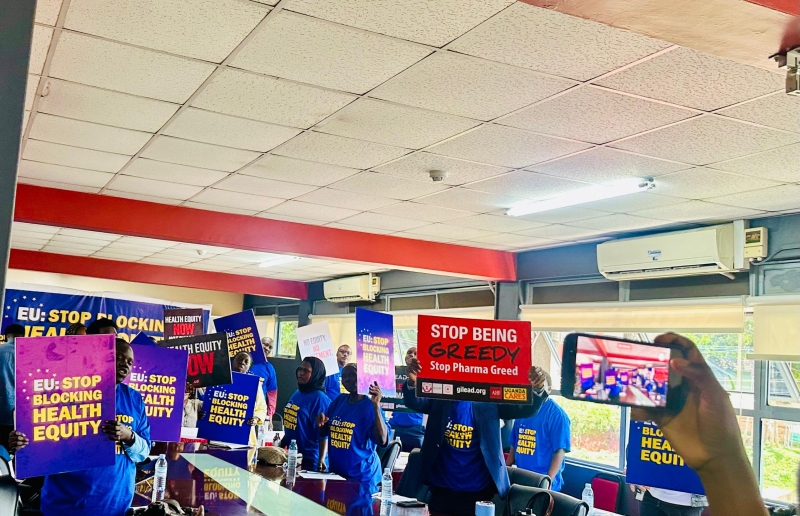
Health partners in Uganda are advocating for inclusion of African countries in the WHO Pandemic Agreement primarily to correct the profound inequities of the COVID-19 era and to ensure that when the next pandemic strikes, they are not left behind as passive recipients of aid, but are active partners with guaranteed access to life-saving tools .
Uganda stands in solidarity and their push is rooted in the bitter lessons of the past.
During COVID-19, African countries shared crucial data—like the Omicron variant sequence—only to face vaccine hoarding by wealthy nations and punitive travel bans as highlighted by Dr. Lubanga Augustine National Medical Director AHF Uganda Cares.
European union goal is to complete the annex in time for presentation and consideration at the 79th world health assembly in May 2026 which partners call for a reverse and consideration before the deadline.
"This experience has galvanized the continent to demand a system built on fairness and reciprocity".
At the heart of Africa's advocacy is the establishment of a robust Pathogen Access and Benefit-Sharing (PABS) system under the WHO agreement .
The concept is straightforward but revolutionary in practice:
African countries would rapidly share information about emerging pathogens with pandemic potential through a centralized WHO system .
In return, they would have a guaranteed right to share in the benefits that result from that data, such as vaccines, diagnostics, and treatments developed by pharmaceutical companies .
For African nations, this exchange must be binding and enforceable.
They argue that the current draft agreement, while a step forward, has weak clauses that lack teeth, leaving critical terms like intellectual property waivers and pricing undefined .
As a unified bloc , partners insist that all pathogen information flow exclusively through this multilateral system to ensure transparency and equity .
The push for a collective, global agreement is made even more urgent by direct pressure on individual African nations to make separate deals.
Several countries are reportedly under pressure from the United States to sign bilateral memorandums of understanding (MOUs).
These agreements would trade access to pathogen data for continued health aid .
Critics describe these bilateral deals as "extraction dressed as cooperation" with Key concerns including
The MOUs reportedly offer "zero promise" of access to any drugs or vaccines developed from the data .
These parallel agreements threaten to undermine the multilateral PABS system, weakening global preparedness and the collective bargaining power of African nations .
The deals would lock countries into long-term data-sharing arrangements without reciprocal, binding benefits for their citizens .
Beyond securing access to medical products, partners view the Pandemic Agreement as a vehicle to build long-term health sovereignty.
The goal is to ensure that by 2035, the continent produces 55% of its health products and 50% of its vaccines, moving away from dependency on imports .
They advocate for the agreement to include firm commitments on transferring technology, which would enable regional production and innovation .
By negotiating as one bloc, African nations—through the African Union and Africa CDC—aim to transform their collective vulnerability into collective strength, stabilizing the global health system in the process .
In essence, Africa's advocacy for the WHO Pandemic Agreement is a fight for dignity and equity.
It is a demand to move from being a donor-recipient to an equal partner in global health security, ensuring that the world benefits from their data and they, in turn, benefit from the world's science.








Disqus comments error!
Disqus shortname is required to use Disqus comments. Please ensure you have specify a valid registered Disqus shortname.