
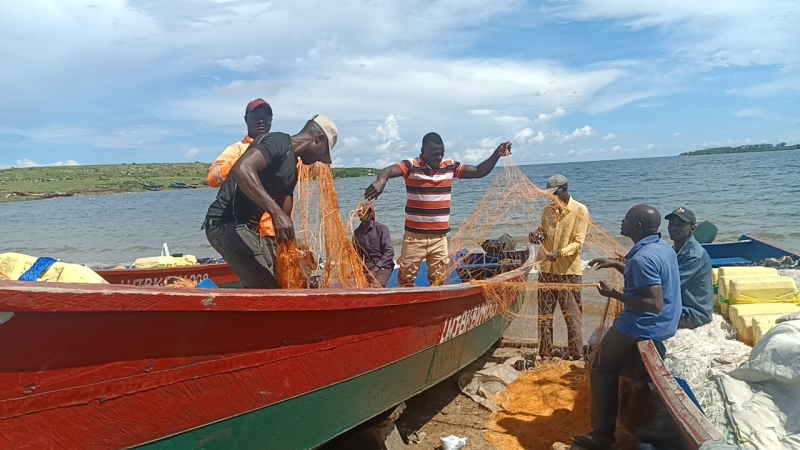
Hundreds of frustrated fishermen, accompanied by their Beach Management Unit (BMU) leaders at Lwajje Island are demanding the immediate arrest and prosecution of illegal Mukene fishers whom they accuse of destroying Lake Victoria’s fish stocks with the tacit support of some soldiers.
The demonstrators voiced deep anger over what they describe as selective enforcement of fisheries regulations. While legitimate fishers have heeded a presidential directive banning the harvesting of Mukene ( Rastrineobola argentea locally known as silver fish), others continue the practice using destructive methods, they claim.
Edward Mudde, Chairperson of the BMU at Bank Landing Site, was blunt in his criticism. “The President banned catching Mukene after it became clear that illegal ‘Hurry Up’ nets and other undersized gear were catching juvenile fish and threatening the future of the lake,” he said. “Yet on islands like Lukalu, Kibibi, Muwama, Maligya, Muto and several others, the illegal fishing goes on openly. Worse still, some soldiers are protecting these criminals instead of stopping them.”
Tensions boiled over at the Lwajje police post, where several boats and pressure lanterns seized from suspected illegal fishers were being held. Eyewitnesses reported a heated confrontation when soldiers allegedly attempted to release the suspects and their equipment. The situation was only calmed after the intervention of the Resident District Commissioner (RDC), Hajjati Hawa Ndege Nyago.
David Kilyowa Sunday, Chairperson of the Lwajje Sub-county BMU, which oversees 13 landing sites, said the President’s clear instructions to protect the lake are being undermined. “We are committed to sustainable fishing, but how can we succeed when the very people tasked with enforcement are looking the other way?” he asked.
Kilyowa highlighted the resource constraints faced by BMU committees. “We lack fuel for patrols and basic equipment to do our work effectively. We appeal to the government and the Department of Fisheries Resources to support us so we can genuinely protect this resource that feeds our families and the nation.”
The protests also brought forward the voices of women in the fishing communities. Betty Tulibona, the women’s representative at Bank Landing Site, shared a personal story that resonated with many. “I used to fish for Mukene, but when the President gave the directive, I stopped. I even destroyed my own boat,” she said. “It pains me to see others continuing this illegal business. Yes, we benefited from it, but we must also think about the future of the lake. We are now grounding our boats and calling on the government to act firmly and to involve women in the enforcement process.”
Fishermen from multiple landing sites raised additional grievances, including rampant theft of fishing gear and the use of illegal nets. They accused some security personnel of colluding with destructive fishing operators, a situation they say is undermining years of efforts to restore fish stocks in Uganda’s portion of Lake Victoria.
Moses Kizito Bbuuule, Assistant RDC, acknowledged the complaints and sought to reassure the fishermen. “BMU committees are the primary overseers of activities on the lake. Soldiers should work hand-in-hand with them, not undermine them,” he said. He urged fishermen to report any soldiers involved in illegal activities, promising that such cases would be investigated and appropriate action taken. On the issue of stolen fishing gear, Bbuuule said directives have already been issued and security efforts would be intensified.
Buvuma District Member of Parliament Robert Migadde Nduggwa addressed the gathering, outlining the broader challenges facing the lake and the steps Parliament has taken to address illegal fishing, including pushing for better enforcement mechanisms and support for local communities.
The protests on Lwajje Island underscore a simmering conflict between conservation efforts and short-term economic survival in one of Uganda’s key fishing districts. With Mukene forming a critical part of the local diet and economy, the success of the presidential ban will likely depend on consistent enforcement, community support, and the elimination of collusion between security forces and illegal operators.
Local leaders and fisheries authorities now face mounting pressure to restore credibility to the regulatory regime before further damage is done to the lake’s fragile ecosystem.








Disqus comments error!
Disqus shortname is required to use Disqus comments. Please ensure you have specify a valid registered Disqus shortname.