
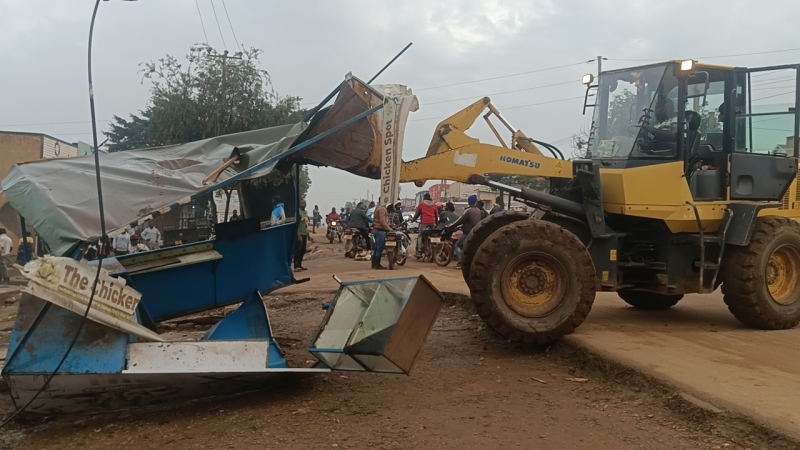
Law enforcement officers backed by the army and police began a major operation this morning to remove hundreds of illegal street vendors operating along roads that were recently widened under a major road expansion project in Mukono town.
The exercise, which kicked off at exactly 5:00 AM, is being led by Gerald Tonny Wamani, Head of Enforcement for Mukono Central Division.
Wamani and his team, supported by a heavy security deployment, started the clearance on Kayunga Road, targeting makeshift stalls and structures that had encroached on the expanded carriageway, including areas previously used as taxi parks.
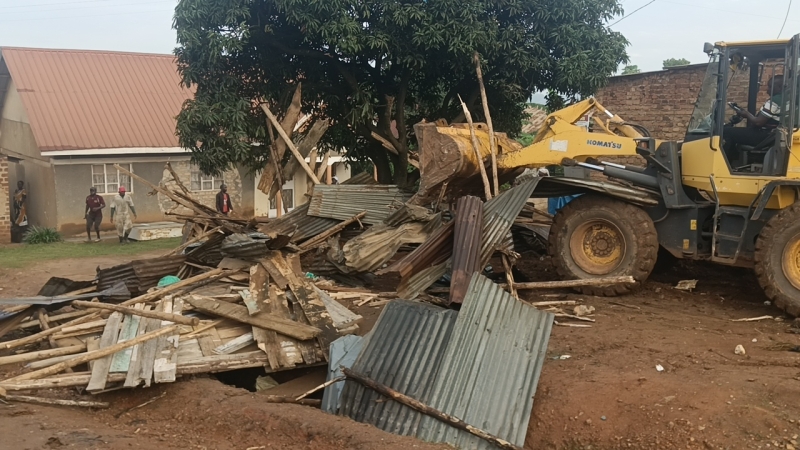
Eyewitnesses described emotional scenes as traders watched their livelihoods being dismantled. Some vendors broke down in tears, pleading with officers for more time to salvage their goods and cash. Others frantically tried to rescue merchandise from the structures before bulldozers and demolition teams moved in.
“The officers told us we had very little time,” one distressed trader said, speaking on condition of anonymity. “Some of these stalls were not just temporary shacks; they had proper foundations. We built them thinking the road expansion was complete and we could operate safely.”
Despite the pleas, the operation pressed on relentlessly. Security personnel maintained a firm presence to prevent any resistance or unrest, ensuring the exercise proceeded without major incidents.
Wamani’s team issued a stern warning to town leaders and officials from various government departments: do not interfere. “Any attempt to interfere with this operation will be dealt with accordingly,” officers reportedly stated.
John Baptist Wamala, the NRM Chairperson for Mukono Municipality, acknowledged the need for the cleanup. “We want to see Mukono cleaned up and well-organized,” he said. “A modern town needs order on its roads.” However, Wamala appealed to the officers to strictly adhere to what had been agreed upon during planning, urging restraint where possible.
Vincent Lukwago, Chairperson of the traders’ association, appealed directly to the affected vendors. “Please remove your belongings quickly before they get destroyed,” he urged. “Do not cause any disturbances that could make the situation worse.”
The operation has since expanded to cover the entire Mukono town, targeting illegal vending spots along major roads and junctions affected by the recent road widening project.
Authorities argue that the encroachments have been hindering smooth traffic flow, posing safety risks to motorists and pedestrians alike, and undermining the objectives of the multi-million shilling road expansion initiative.
Many of the affected traders had been operating from these locations for years, with some claiming they had informal agreements or paid fees to local authorities.
The sudden enforcement has left dozens of families worried about their immediate survival, as the demolished stalls contained not only goods but also daily earnings.
As the sun climbed higher, the sound of hammers, crowbars, and heavy machinery echoed through Mukono’s bustling streets.
Piles of salvaged merchandise from fresh produce and second-hand clothes to household items lay scattered along the roadside as traders hurriedly loaded them onto boda bodas and small trucks.
Local residents expressed mixed reactions. While some welcomed the move, citing improved road safety and reduced congestion, others sympathized with the vendors, many of whom are struggling small-scale business owners with limited alternatives.
The operation was still ongoing late into the afternoon, with officials indicating it could continue for several days until all illegal structures along the expanded roads are cleared.
Mukono Municipality authorities have not yet announced alternative vending sites or compensation plans for the affected traders. Residents and traders have been advised to cooperate with security forces to ensure the exercise is completed peacefully.
This latest enforcement action reflects a broader national effort by Ugandan urban authorities to restore order in rapidly growing towns and cities, particularly after major infrastructure projects.







Disqus comments error!
Disqus shortname is required to use Disqus comments. Please ensure you have specify a valid registered Disqus shortname.